What is a wellness wheel?
A wellness wheel is a circle split into the areas of life that shape how well you feel — usually eight of them, like body, feelings, people and money. You rate each one, and the filled-in shape shows you where life is full and where it’s thin.
The idea goes back to 1976, when Dr Bill Hettler, a co-founder of the National Wellness Institute, drew six dimensions of wellness — physical, emotional, intellectual, social, spiritual and occupational — as the segments of a circle. In 2016 SAMHSA, the US agency for mental health and substance use, published a version with eight, adding financial and environmental. That set is the one most universities, counsellors and wellbeing sites use today, and it’s the one this page uses.
The wheel itself is just a picture. What makes it useful is the question it asks. Not how am I doing?, which is too big to answer honestly, but how has each part of my life felt lately? — which you can answer in a couple of minutes, and which shows you something the single big question hides.
The 8 dimensions of wellness, in plain words
SAMHSA’s names are accurate and a little cold. Here they are with the plain names this page uses, what each one actually covers, and — because Meadow is built for people whose days are mostly spent looking after other people — what it tends to look like for a mother.
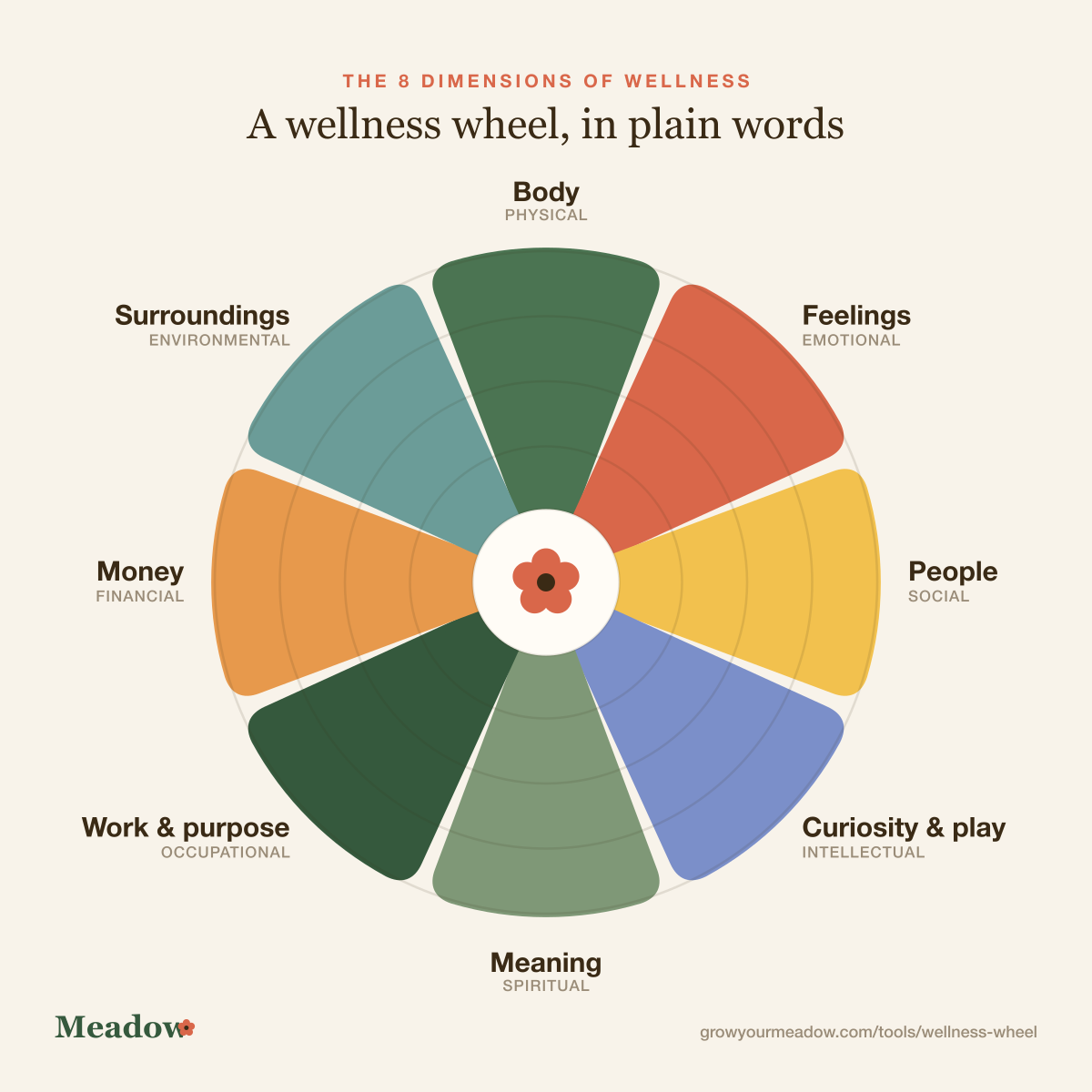
-
Body Physical
Movement, sleep, food, and whether your body gets listened to. Not fitness: nobody is asking about workouts or step counts. It’s whether your body gets to move in some way most days, whether you’re sleeping enough to feel like yourself, whether what you eat leaves you nourished or running on empty, and whether, when your body asks for water or rest or a stretch, it usually gets it. This is the dimension the others lean on. When sleep goes, feelings, patience and play tend to go with it.
For a mother it often looks like moving all day and never once for yourself. -
Feelings Emotional
Knowing what you feel and having ways to steady yourself. Emotional wellness isn’t being happy, and it isn’t being calm all the time. It’s being able to name what’s going on inside, even when it’s messy; having a few things that steady you on a hard day; talking to yourself the way you’d talk to a friend; and letting a feeling be there without rushing to fix it. It’s the quietest dimension, and the first to get skipped.
For a mother it often looks like holding everyone else’s feelings and not being sure what’s left of your own. -
People Social
Who’s around you, and whether time with them fills you up. Not how many friends you have, but whether there’s someone you could call if today fell apart, whether time with people leaves you fuller more often than drained, whether you belong somewhere (a family, a friend, a group, a street), and whether you can say no without carrying the guilt around afterwards. Being surrounded and being supported are different things, and this dimension is about the second one.
For a mother it often looks like being surrounded all day and lonely by nine o’clock. -
Curiosity & play Intellectual
Learning, hobbies, and anything you do just because. The formal name makes it sound like study; it isn’t. It’s whether you’ve tried something new lately because you wanted to, whether you have an interest that’s yours and not for anyone else, whether there are playful moments in your week, and whether your mind gets something to chew on beyond logistics. This is the dimension that goes first when life gets full, and the one people most often forget they’re allowed to have.
For a mother it often looks like not being able to remember the last thing you did just because. -
Meaning Spiritual
What matters to you, and the quiet moments that keep things in proportion. Faith, if you have it; not required. It’s knowing what matters most and having days that mostly reflect it, getting quiet moments — a walk, a prayer, a pause — that put things back in proportion, feeling part of something bigger than the to-do list, and being able to forgive yourself when you get things wrong. That last one is doing more work than it looks.
For a mother it often looks like knowing exactly what matters and having no minute in the day to feel it. -
Work & purpose Occupational
Paid work, unpaid work, caregiving — whether it feels worthwhile and stays in its lane. The occupational dimension has always included volunteering and caring, and this page says so out loud, because for a lot of people the biggest job they have doesn’t come with a salary. It’s whether the work you do feels worthwhile more often than not, whether the things you’re good at get used, whether work stays in its lane instead of swallowing everything, and whether you feel seen for what you put in.
For a mother it often looks like two jobs — one paid, one not — and neither of them noticed. -
Money Financial
Not how much, but how much room it takes up in your head. Financial wellness isn’t wealth. It’s knowing roughly where your money goes and feeling okay about that, money worries not taking more of your head than they should, a surprise expense not derailing everything, and spending that lines up with what you care about. Two people with the same bank balance can be in very different places here, and the difference is usually about knowing rather than having.
For a mother it often looks like doing the household sums in your head at three in the morning. -
Surroundings Environmental
Your home, your air, your corners of calm. Not the planet — though that counts too — but the spaces you actually spend your days in. It’s whether your home has at least one corner that feels calm, whether you get outside into fresh air more days than not, whether your spaces feel safe and mostly yours, and whether you can find what you need without wading through clutter. Surroundings shape mood more than most of us admit, and they’re often the easiest dimension to change.
For a mother it often looks like a house full of everyone’s things and nowhere that’s yours.
How to use a wellness wheel (without turning it into a report card)
Most guides tell you to score each area from one to ten and colour it in. That’s fine on paper. It’s also how a wellness wheel turns into one more thing you’re failing at. Four things make the difference.
- Answer for lately, not for the person you mean to be. The tool asks about the last couple of weeks. Not your best month, not your worst, and not what you’d do if you had more time. If you answer for the self you’re trying to become, the wheel will be a picture of an intention rather than of your life, and it won’t tell you anything.
- Read the shape, not the score. There’s no total here, and that’s on purpose. A wheel of steady middles rolls better than one with two full petals and two empty ones. Look at where it’s lopsided and where it’s even. That’s the information.
- Pick one petal. Not the three lowest. One — ideally the one that would make the others a bit easier, which for most people is Body or People. Give it something tiny this week. The tool suggests one small thing; you’re welcome to ignore it and pick your own.
- Come back in a month. Your wheel is saved on this device. Do it again in four weeks and compare the shapes. That comparison is worth more than any single wheel, because it shows you what a season did.
If you scrolled here without doing it, the wheel is at the top of this page. It takes about three minutes.
Reading your wheel: what a low spoke actually means
A low petal is information, not a failing. It says: this area has been getting less than it needs lately. It doesn’t say why, and it doesn’t say whose fault it is. Usually the answer is nobody’s, and the reason is that something else needed the energy.
Wheels have seasons. After a baby, most of the wheel rests. During an illness, Body and Curiosity go quiet while People, if you’re lucky, fills in. After a move, Surroundings and People dip together. A wheel that’s mostly small isn’t a diagnosis; it’s what carrying a lot for a while looks like when you draw it as a circle. The tool has a specific reading for that shape, because it’s the one most guides ignore and the one most likely for the people Meadow is made for.
What a low petal asks for isn’t effort. It asks for one small thing, done kindly, and then left alone to work. Two minutes outside. A text. Water before coffee. And if most of the wheel has been small for a long time and nothing shifts, that’s worth telling someone: a GP, a friend, a counsellor. That isn’t a last resort. It’s the strong move.
Want it on paper? Print, download or email your wheel
Once you’ve answered, the Keep it row under your readings gives you a few ways to hold on to it. Nothing is stored on our side for any of them.
- Print / save as PDF prints your wheel with its eight readings. The print dialog on any phone or computer has a “Save as PDF” option, so one button covers both.
- Save as image makes a PNG of your wheel in your browser, for your camera roll or your notes app.
- Copy link gives you a link that redraws this exact wheel. The link is the wheel; open it next month and it’s there.
Want a blank one? Print a blank wheel, under the wheel itself, prints the empty wheel with all 32 statements and their blank answer pills, so you can fill it in by hand or hand it to someone who’d rather not do it on a screen. No email, no PDF to hunt for. It’s the page itself, printed.
Wellness wheel vs wheel of life
They look the same and they’re often confused, but they come from different places and ask different questions. The wellness wheel comes from health — Hettler’s six dimensions, SAMHSA’s eight — and its segments are dimensions of wellbeing: physical, emotional, social and so on. The wheel of life is a coaching tool, usually credited to Paul J. Meyer of the Success Motivation Institute in the 1960s, and its segments are areas of life: career, money, health, family and friends, romance, personal growth, fun, home. You rate each one out of ten and connect the dots.
Same picture, different job. The wheel of life is good for deciding what to work on; the wellness wheel is better for noticing how you actually are. If you feel tired rather than stuck, start with this one.
And the third thing with the same name: the Buddhist wheel of life, the bhavachakra, is a painted diagram of the cycle of existence that you’ll find at the entrance to Tibetan temples. Beautiful, ancient, and nothing to do with either of the above.